


SOCSO (PERKESO) Malaysia 2026 Update: Key Changes & Employer Guide

KOR HUI PING - June 25, 2026

Policy Overview
The Social Security Organization (SOCSO), also known as PERKESO, is a statutory body under the Ministry of Human Resources Malaysia.
It provides social protection coverage for employees under the Employees’ Social Security Act 1969 (Act 4), including protection for workplace injuries, invalidity, occupational diseases, and death.
This article highlights the key SOCSO updates in 2026, with a focus on coverage enhancements for both local and foreign workers.
Social Security Organization (SOCSO) OVERVIEW
The Social Security Organization (SOCSO), also known as PERKESO, is a statutory body under the Ministry of Human Resources, Malaysia. It was established under the Employees’ Social Security Act 1969 (Act 4) to administer and implement social security protection schemes for employees in Malaysia.
SOCSO provides social protection coverage to employees in the private sector through various schemes, including employment injury protection, invalidity protection, employment insurance, and extended coverage programs.
Its main objective is to ensure financial security, medical assistance, and income replacement for employees in cases of employment injury, invalidity, unemployment, or other covered risks.
Protection Schemes for Employees in Malaysia
Who is a "Local Employee"?
A local employee generally refers to an employee who is covered under PERKESO and employed under a contract of service or apprenticeship with an employer, subject to the requirements under the Employees’ Social Security Act 1969 (Act 4).
Who is a "Foreign Worker"?
A foreign worker generally refers to a non-Malaysian citizen who is legally employed in Malaysia under a valid work permit, employment pass, or other approved employment authorization. Foreign workers employed under a contract of service are covered under PERKESO protection schemes, subject to the requirements of the Employees’ Social Security Act 1969 (Act 4).
Eligibility Conditions for Foreign Workers:
Must possess a valid passport
Must possess a valid work pass (Visit Pass for Temporary Employment, Employment Pass, Special Pass, or other related passes)
Be registered with PERKESO by their employer
PERKESO provides several protection schemes for employees in Malaysia, including local employees and foreign workers. The schemes available depend on the employee category and eligibility requirements.

Understanding SOCSO Protection Schemes for Local Employees and Foreign Workers in Malaysia
SOCSO (PERKESO) provides social security protection for both local employees and foreign workers in Malaysia. Under the current framework, both groups are covered under the Employment Injury Scheme and Invalidity Scheme. However, the Employment Insurance System (EIS) applies only to local employees and does not cover foreign workers.
Employment Injury Scheme (Lindung Pekerja)
The Employment Injury Scheme protects employees against accidents and occupational diseases arising out of and in the course of employment. It focuses on work-related incidents and ensures that employees receive financial and medical support when they suffer injuries connected to their work.
What does it cover?

Note: Commuting accident coverage applies to journeys directly related to employment, provided there are no significant interruptions or deviations from the normal route.
Eligible employees or their dependants may receive the following benefits under the Injury Scheme, subject to PERKESO’s eligibility requirements:

All benefits and payment rates are subject to revision by PERKESO. Please refer to official SOCSO sources for the most updated information.
Invalidity Scheme (Lindung Pekerja)
The Invalidity Scheme provides protection for insured employees against invalidity or death arising from any cause, whether related or unrelated to employment, subject to PERKESO requirements.
Unlike the Employment Injury Scheme, protection is not limited to workplace incidents.
What is Invalidity Scheme?
According to PERKESO, invalidity refers to a permanent condition that is unlikely to be cured and significantly reduces a person's ability to earn a living.
What does it cover?

Eligible employees or their dependants may receive the following benefits under the Invalidity Scheme, subject to PERKESO’s eligibility requirements:

All benefits and payment rates are subject to revision by PERKESO. Please refer to official SOCSO sources for the most updated information.
Employment Insurance System (Lindung Kerjaya)
The Employment Insurance System (EIS) provides financial and re-employment support to employees who lose their jobs due to eligible loss of employment situations.
Important: The Employment Insurance System (EIS) applies to eligible insured employees in Malaysia, including Malaysian citizens and permanent residents. Foreign workers are not covered under EIS.
What does it cover?

What support does EIS provide?

Eligible employees or their dependants may receive the following benefits under the Employment Insurance System, subject to PERKESO’s eligibility requirements:

Eligibility: Apply within 60 days from date of Loss of Employment (LOE) and must satisfy Contributions Qualifying Conditions (CQC). LOE must be as defined under the EIS Act.
All benefits and payment rates are subject to revision by PERKESO. Please refer to official SOCSO sources for the most updated information.
NEW SOCSO Scheme — LINDUNG 24 Jam (Non-Employment Injury Scheme)
Effective: 1 June 2026
LINDUNG 24 Jam is a brand new scheme introduced by PERKESO to provide round-the-clock protection for eligible employees throughout their entire employment period including accidents that occur outside working hours and are not directly related to their job or duties.
Definition of Non-Employment Injury:
A personal injury caused by an accident that does not arise out of and in the course of employment, and does not include any circumstances specified under Section 96B of Act 4.
What does LINDUNG 24 Jam cover?
Examples may include accidents occurring during daily activities outside work, such as non-work-related incidents.
Key Benefits:
Benefits may include medical treatment and other protection benefits subject to PERKESO’s terms and conditions.
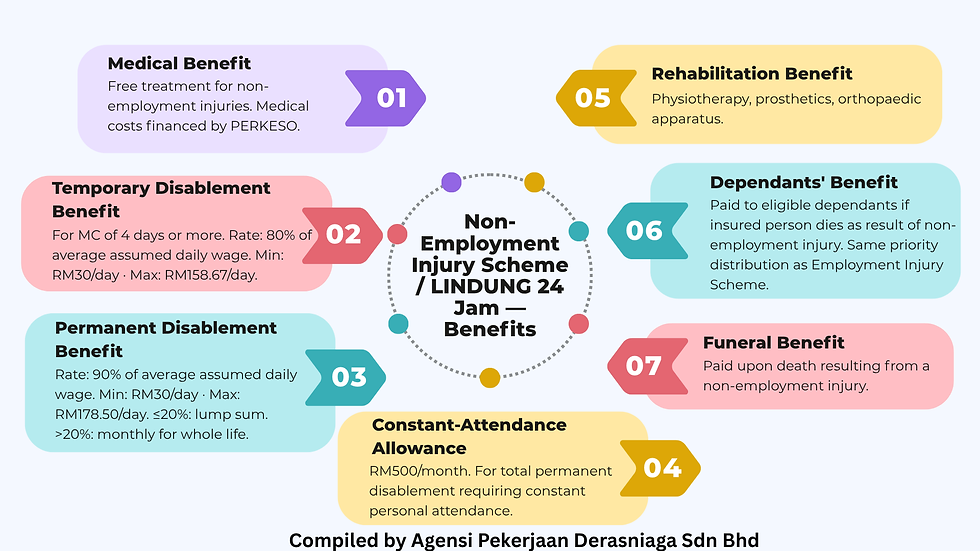
Note: Benefit structure mirrors the Employment Injury Scheme, applied to non-employment injuries. Covers home accidents, road accidents (non-work), daily life accidents, and leisure activity incidents.
Below criterias are not covered under LINDUNG 24 Jam scheme:-
Accidents outside Malaysia
Illness-related conditions (fever, diabetes, hypertension, etc.)
Self-employed injuries
Domestic worker injuries
Foreign workers who violated valid pass conditions
Contribution Rate by Employee by Phases for LINDUNG 24 Jam
According to PERKESO (SOCSO), the LINDUNG PEKERJA contribution is split into two parts: the Employment Injury Scheme (fixed at 0.5%) and the new 24-Hour Protection (LINDUNG 24 JAM).
The 24-hour protection is introduced gradually in phases, increasing from 0.75% (Phase 1), to 1.0% (Phase 2), and 1.25% (Phase 3), which causes the total contribution to rise over time as coverage expands.

Notes
Contributions are mandatory and fully borne by the employee.
Employers are responsible for deducting and remitting contributions on behalf of employees for as long as employment continues.
Local Employee vs Foreign Worker
This comparison highlights the key PERKESO (SOCSO) protection benefits available to local employees and foreign workers in Malaysia. While both groups are covered under the Employment Injury Scheme, Invalidity Scheme, and LINDUNG 24 Jam, certain benefits such as Employment Insurance (EIS) and Education Loans remain exclusive to local employees. Foreign workers may also be eligible for selected benefits and the Funeral Repatriation Initiative, subject to PERKESO's terms and eligibility requirements.

SOCSO Before vs After 1 June 2026
This comparison highlights the expansion of PERKESO protection from 1 June 2026. Through LINDUNG 24 Jam, employees receive 24-hour coverage for non-work-related accidents in addition to existing Employment Injury and Invalidity Scheme protection, resulting in broader social security coverage for both local and foreign workers.

SOCSO Claim Process
Step-By-Step on How to Apply for SOCSO Benefits
All benefit applications must be submitted to the nearest PERKESO office to be reviewed and verified by PERKESO officers.
Applications can also be initiated online via the Portal LINDUNG FAEDAH for Accident Notice, Occupational Disease Notice, and Death Notice.
STEP 1 — Notify Your Employer Immediately
Employee must inform the employer as soon as possible after a workplace accident, commuting accident, occupational disease diagnosis, or non-employment injury (LINDUNG 24 Jam).
If the employee is unable to notify (e.g. severe injury), a family member or colleague may notify on their behalf.
The employer must then report the accident to PERKESO within 48 hours of receiving the notification — this is a legal obligation under the Employees' Social Security Act 1969 (Act 4). Failure to report is a criminal offence.
STEP 2 — Seek Medical Treatment
Employee seeks treatment at a PERKESO panel clinic, government clinic, or government hospital.
The attending doctor will:
Issue a Medical Certificate (MC) confirming the condition and period of leave.
Complete Form 10 (Medical Report) confirming the injury/condition for benefit claim purposes.
STEP 3 — Download & Complete the Claim Form (Borang 34)
Download Form 34 (Borang 34) — the main benefit claim/accident report form.
Refer to the Borang 34 Guideline for instructions on how to fill it in correctly.
Complete only the sections marked (✓) that apply to your benefit type.
The employer is responsible for completing the employer section of Borang 34.
Additional forms required by benefit type:
Benefit Type | Forms Required |
Temporary Disablement Benefit (TDB) | Form 34 + Salary/Contribution Statement (PKSF1) + Insured Person Declaration (Perakuan BK1) |
Permanent Disablement Benefit (PDB) | Borang Permohonan FHUK + Medical Report (Laporan Perubatan) |
Invalidity Pension | Form 34 + Medical Report (Laporan Perubatan) + Borang A (Payment Participation) + Insured Person Declaration |
Survivors' Pension | Form 34 + Borang A (Payment Participation) + Dependant Declaration (Perakuan Orang Tanggungan) |
Occupational Diseases | Form 34 + Medical Report + Salary/Contribution Statement |
Foreign Worker Claims | Form 34-PA (Foreign Worker version) + Checklist documents |
Foreign Worker specific forms:
STEP 4 — Prepare Supporting Documents
Gather all required supporting documents before submitting. Common documents include:
Completed Form 34 (Borang 34)
Copy of employee's NRIC (IC) or passport (foreign workers)
Original Medical Certificate (MC) for the entire leave period
Medical Report (Form 10 / Laporan Perubatan) — completed by attending doctor
Salary/contribution statement for the relevant period
Attendance records
Police report — may be required for commuting accident claims, particularly in road traffic cases, depending on case assessment
Death certificate — for Survivors' Pension / Dependants' Benefit claims
Dependant documents (birth certificate, marriage certificate) — for Survivors' or Dependants' Benefit
STEP 5 — Submit to the Nearest PERKESO Office
Submit the completed forms and all supporting documents at the counter of the nearest PERKESO office.
Alternatively, for Accident Notice / Occupational Disease Notice / Death Notice, applications can be initiated online via: Portal LINDUNG FAEDAH
For EIS (retrenchment) benefit applications, apply via: lindungkerjaya.perkeso.gov.my
PERKESO officers will review and verify the submitted documents at the office.
STEP 6 — PERKESO Review & Medical Board Assessment
PERKESO reviews Form 34, Form 10, and verifies the employee’s contribution history. Processing time depends on the completeness of documentation and case complexity.
Temporary Disablement Benefit (TDB):
Straightforward cases are processed after verification of complete documents. Processing time may vary depending on case conditions.
Permanent Disablement Benefit (PDB):
Cases may be referred to the Medical Board for assessment of the degree of disability. This may affect overall processing time.
Invalidity Pension / Survivors’ Pension:
Medical Board or Appellate Medical Board assessment may be required depending on eligibility and case conditions.
STEP 7 — Approval & Compensation Payment
Once approved, benefit payments are made directly into the claimant’s bank account.
Temporary Disablement Benefit (TDB):
Paid during the medical leave period after the waiting period (generally after the first 3 days of MC), subject to SOCSO assessment and eligibility.
Permanent Disablement Benefit (PDB):
Payment structure depends on the degree of disability assessed by SOCSO. It may be paid as a lump sum or pension depending on the case.
Invalidity Pension / Survivors’ Pension:
Paid monthly based on eligibility and Medical Board evaluation.
Funeral Benefit:
A one-time benefit of up to RM3,000 is provided under SOCSO’s death benefit scheme. For foreign workers, repatriation assistance may be provided up to RM7,500 depending on case requirements.
Important Deadlines
Deadline | Details |
Employer accident report | Within 48 hours of receiving notification from the employee, in accordance with SOCSO reporting guidelines. |
Benefit claim submission | Within 12 months from the date of accident or date of disablement, subject to SOCSO requirements. |
EIS benefit application | Within 60 days from the date of Loss of Employment (LOE) |
Conclusion
The 1 June 2026 update marks a significant expansion of SOCSO’s protection framework. With the introduction of LINDUNG 24 Jam, employees are now provided with additional 24-hour protection covering non-work-related accidents in addition to existing SOCSO schemes.
For employers and HR professionals, this update requires operational adjustments to ensure compliance and accurate contribution management.
Key employer considerations:
Employers are advised to update payroll systems to include the new LINDUNG 24 Jam employee contribution (0.75% in Phase 1).
Foreign worker contributions now include Employment Injury Scheme, Invalidity Scheme, and LINDUNG 24 Jam.
Clear communication should be provided to employees regarding the new deduction and its benefits.
Timely registration and contribution must be ensured, as non-compliance with the
Employees’ Social Security Act 1969 (Act 4) may result in penalties upon conviction.
Recruitment agencies and HR professionals play an important role in supporting employers’ compliance and ensuring that both local and foreign workers receive full social protection under Malaysia’s enhanced SOCSO framework.
About Us
At Agensi Pekerjaan Derasniaga Sdn Bhd, we assist businesses in areas such as Human Resource compliance, recruitment coordination, foreign worker management, documentation handling, and workforce administration. By simplifying complex Human Resource processes, businesses can reduce compliance-related risks while maintaining smoother day-to-day operations.
We work closely with companies to ensure workforce practices remain aligned with current labour requirements and operational needs.

Disclaimer
The information provided in our blog articles is intended for general informational purposes only. It is not a substitute for professional advice and should not be relied upon as such.
While we strive to provide accurate and up-to-date information, the ever-evolving nature of certain topics may result in content becoming outdated or inaccurate over time. Therefore, we recommend consulting with qualified professionals or experts in the respective fields for specific advice or guidance. Any actions taken based on the information contained in our blog articles are solely at the reader's discretion and risk. We do not assume any responsibility or liability for any loss, damage, or adverse consequences incurred as a result of such actions.
We may occasionally provide links to external websites or resources for further information or reference. These links are provided for convenience and do not imply endorsement or responsibility for the content or accuracy of these external sources. Our blog articles may also include personal opinions, views, or interpretations of the authors, which do not necessarily reflect the views of our organization as a whole. We encourage readers to verify the accuracy and relevance of information presented in our blog articles and to seek professional advice when needed.
Your use of this website and its content constitutes acceptance of this disclaimer.

https://soicaulodechuan.mobi/giai-ma-so-hoc cái mình để ý trước lại là mục lục chứ chưa phải nội dung về số. Bài nhiều chữ mà có sẵn các đầu mục ở trên thì đọc lướt cũng nhẹ đầu hơn, ít nhất biết đoạn nào có thông tin mình đang muốn xem. Mình hay tranh thủ mở vài phút thôi nên khá thích kiểu trình bày này, không cần đọc hết từ đầu mới biết bên dưới có gì. Còn chuyện nhận định đúng sai thì mình chưa bàn, ở đây chỉ nói chút về cách chia nội dung. Nhìn các phần được đánh số rõ ràng thấy dễ theo hơn một đoạn dài liền tù tì. Riêng bảng kết quả xổ số miền Bắc…
qq88 nạp tiền tối qua mình có vào lướt một chút lúc rảnh. Mình không đọc kỹ nội dung hay ngồi canh từng mục gì đâu, chủ yếu xem giao diện có dễ nhìn không, và bất ngờ là trang trông khá thoáng nên kéo lên kéo xuống không bị ngợp, chữ với khoảng trắng cân đối nên mắt bắt thông tin nhanh hơn mình nghĩ. Cái mình thích là menu đặt ngay chỗ dễ thấy, bấm chuyển qua lại mấy phần cũng mượt và không bị lạc, mấy bảng thông tin chia theo cột nhìn gọn nên dù mình dùng màn hình nhỏ vẫn theo kịp. Nói chung lướt nhanh thôi cũng nắm được hướng đi, nhất là nhờ…
32 WIN tối qua mình tranh thủ lướt lúc nghỉ tay một chút, kiểu vào xem cho biết thôi vì thấy tên này xuất hiện nhiều. Mình vốn hay ngại mấy trang trình bày lộn xộn, nhưng bên này nhìn qua lại dễ định hướng hơn mình tưởng, nên bấm qua lại vài mục cũng không mất công dò. Có cái mình thích là phần thông tin họ để dạng bảng theo cột nhìn gọn, đọc lướt là nắm được ý chính, đỡ phải kéo qua kéo lại mệt. Mình cũng để ý thanh menu đặt ở chỗ dễ thấy nên chuyển mục nhanh (đang xem dở cũng quay lại được liền), cảm giác dùng kiểu vài phút vẫn ổn.…
https://rr88m1.com/ lúc đầu mình cũng hơi lăn tăn, vì mấy trang kiểu này dạo gần đây nhìn hao hao nhau nên mình chỉ mở lên xem giao diện ra sao thôi; kéo xuống một chút thì thấy họ trình bày khá gọn, các khối nội dung tách bạch nên đọc lướt vẫn bắt nhịp được, chữ không quá rối; mình chú ý nhất là phần họ để thông tin nguồn gốc/pháp lý kiểu công khai ngay trên web, ai muốn kiểm tra nhanh thì đỡ phải mò; thao tác chuyển mục cũng ổn, bấm qua lại không thấy đứng hình hay chờ lâu; mình không vào sâu mấy phần game hay ưu đãi, chỉ xem cách sắp xếp cho người…
Mình mua vé số chủ yếu cho vui thôi, kiểu có thêm chút hồi hộp mỗi lần chờ kết quả chứ không đặt nặng chuyện đổi đời. Trước đây nghe bạn bè bàn về “cầu” các kiểu, mình cũng thử để ý xem sao, theo dõi một thời gian thì thấy thỉnh thoảng có vài chỗ trùng lặp làm mình tò mò. Mỗi khi đọc bài soi, mình hay note lại vài ý ngắn rồi vài hôm sau lôi ra so với kết quả để tự kiểm tra xem mình có bị cảm tính không. Dạo này có lần mình ghé https://soicauxsmb.io/soi-cau-giai-dac-biet.html để xem thêm một góc nhìn, nhưng vẫn nhắc bản thân chỉ tham khảo. Có hôm trúng chút…